

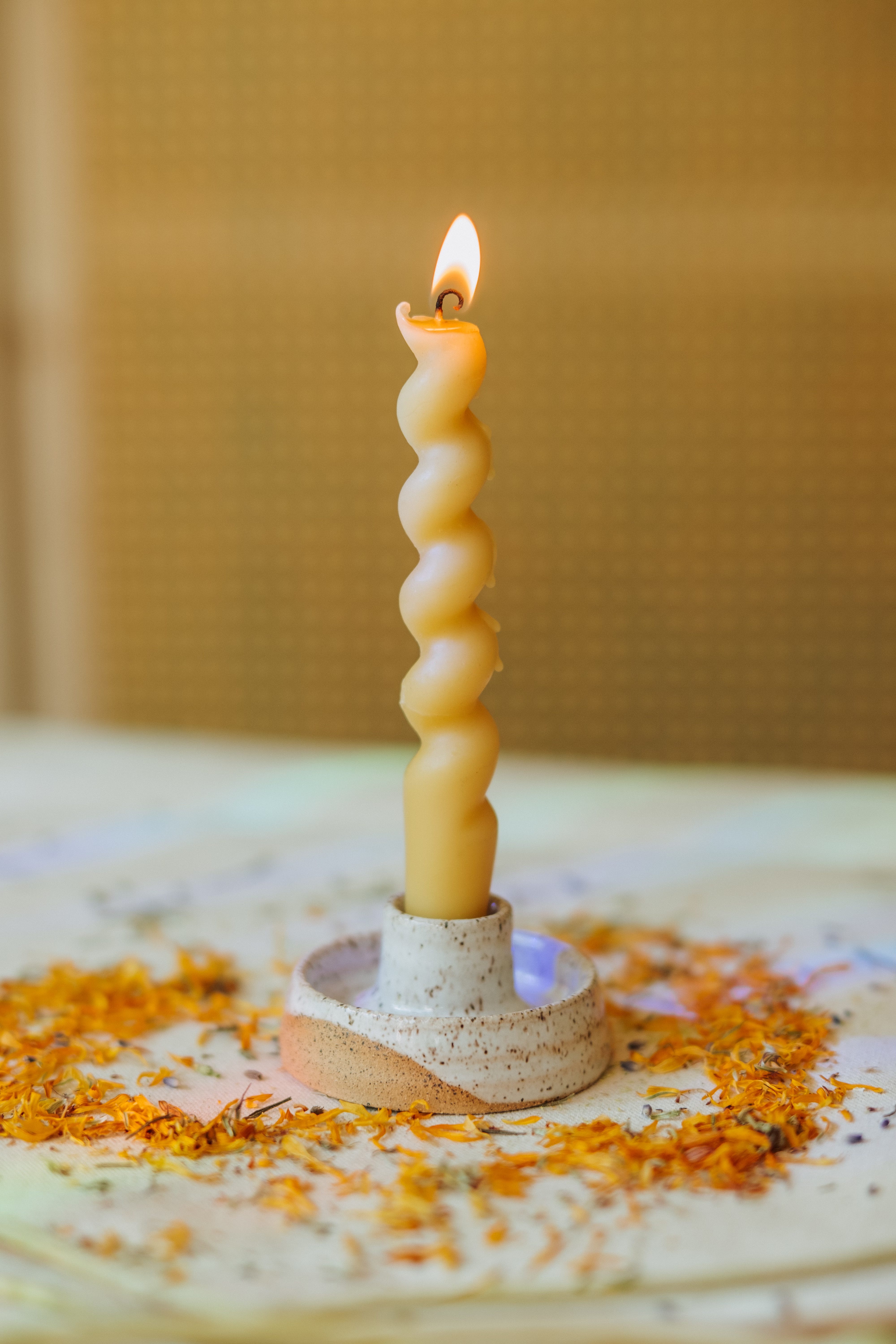
Lighting a candle near you is a great way to not only set a cozy ambience and get in the mood for thoughtful creation, but it also serves as an old-fashioned way of keeping time. Before electricity, households relied on fires and candlelight to extend their days, especially during the cold winter months. Candles have long been favored for sacred timekeeping, allowing the burn to measure the hours passed until the glow extinguishes.
Tea light candles generally last about two hours from start to finish, which I tend to burn for small projects and long tapers for a full-on focus session. Work until the flame self-extinguishes as a way to stay present and transport yourself into your dream art studio. Much like how a distinct scent or a particular song can take you back to a certain time in your life, we want to train ourselves to memorize moments of peace in the studio by making the setup a habit. Having the right space to work is almost as important as the work itself.
I had an English teacher in middle school who played “Come Together” by the Beatles every morning, after the bell rang, as we sat in our seats writing what would now be considered morning pages. As silly as it felt back then, it was training a habit that set up a safe space for our thoughts to wander and our nervous systems to regulate.
If you live in a full household, let your family, friends, and or housemates know that from 4-6 pm, or whatever time you decide to choose, that time is yours. No disruptions are allowed as you are dedicating time to your art practice and are taking it seriously, logging the hours like a part-time job. Once you are clocked in… no phones… no outside world… just you and your creativity.
Structuring your time is more about commitment to consistency than it is about having enough of it. Let’s be real and think about how much time we spend sitting on the porcelain throne scrolling on our phones. Some of us are racking up enough screen time to the point where our legs get numb due to the loss of blood circulation, and the feeling of poking needles takes over. I know this all too well from personal experience, and the fact that you are grinning while reading this tells me you do too.
Imagine if those extra fifteen unnecessary minutes on the toilet every day were merged and reserved for your art practice, you would have three hours and some change per week to write, compose, or paint to your heart’s content. When I was a kid, my mom would tape alphabet, words, and phrases of various languages on the back of the restroom door to pass the time doing our business. With fluency and conversational knowledge of three languages years later, I think it is safe to say it worked. Still to this day, I find myself taping sticky notes of phrases in Italian to the inside of my vanity mirror, so as I floss and brush my teeth, I can put in the time to learn a new language.
It comes to show that the amount of effort it takes to complain about how little time we have for the things we want to do is the same effort it would take to do the things we already do. Adjusting our environment and changing our mindset is all it takes to constantly show up to our art practice and actively choose devotion over discipline.